 IVF TREATMENT ISTANBUL
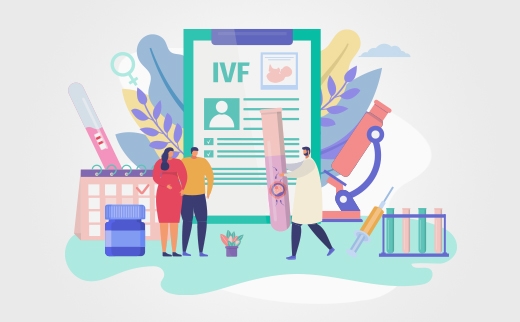
IVF Treatment in Turkey
One of the best-known fertility treatments is in vitro fertilization, also known as IVF, a technique whereby eggs are collected from the ovaries and fertilized in the laboratory (in vitro) with sperm then the embryos placed into the womb to grow and develop.
IVF treatment in Turkey is affordable and yields higher success rates than in many other countries. The success rate of fertility clinics in Turkey is well-known in all other European countries, the U.S., Russia, Africa, Asian countries, and the Middle East. Besides the cost advantage and high success rates in IVF treatment, touristic opportunities make Turkey one of the most desirable countries in the world. There is no waiting list for IVF treatment at our IVF clinic in Istanbul, Turkiye. We start IVF treatment according to the patients’ availabilities.
IVF treatment costs in Turkey vary depending on the clinic, individual treatment protocol, medication requirements and any additional procedures that may be needed. For detailed and up-to-date information about treatment packages and additional expenses, please see our IVF Cost 2026 in Istanbul, Turkey guide.
The experience of the fertility specialist and the quality of the embryology laboratory are important components of IVF treatment. During the treatment cycle, patients attend scheduled monitoring appointments so that ovarian response and treatment progress can be evaluated and the protocol adjusted when necessary.
What is infertility?
Infertility is defined as failure to achieve pregnancy after 12 months or more of regular unprotected sexual intercourse. Fertility evaluation is generally recommended after 12 months for women under 35 and after 6 months for women aged 35 and over. Earlier evaluation may be appropriate when there is a known condition that can affect fertility.
Infertility may result from female factors, male factors, a combination of both or unexplained factors. According to the World Health Organization, approximately one in six people of reproductive age experience infertility during their lifetime.
What causes infertility?
The most important causes of infertility in women are ovulation problems, endometriosis or damaged or occluded fallopian tubes. Male factor infertility includes low sperm count, decreased sperm motility, and no sperm count.
After initial examinations and tests have been done, one of the treatments out of ovulation induction treatment, intrauterine insemination (IUI) or in vitro fertilization (IVF) treatment is decided according to the reasons of infertility in the couples.
What is IVF treatment?
Following the birth of Louise Brown in 1978, live births after IVF treatment occurred in Australia in 1980, in the USA in 1981 and in Sweden and France in 1982. Although its original intention was to treat women with tubal disease, IVF treatment can help couples overcome various types of infertility.
IVF Treatment allows scientists to manipulate the fertilization process in order to bypass some pathological obstacles such as blocked fallopian tubes and non-functioning ovaries in the females, and blocked vas deferens and low sperm count in the males.
In IVF treatment, the eggs are removed from the woman and fertilized in the laboratory environment with the sperm of the male and the resulting embryo is placed in the womb. Methods of IVF treatment have advanced dramatically since the first IVF baby was born in 1978.
What Is the Cost of IVF Treatment in Turkey?
The cost of IVF treatment in Turkey can vary depending on the clinic, treatment protocol, medications required and any additional procedures.
At our clinic in Istanbul, the typical IVF-ICSI treatment cost ranges from €3,500 to €3,800, depending on the individual treatment plan and the patient's medical needs. Medications used for ovarian stimulation are not included in this package price.
The standard IVF-ICSI treatment package includes:
- Medical management of the IVF treatment cycle
- Monitoring and ultrasound scans
- Egg retrieval under general anaesthesia
- Sperm preparation
- IVF or ICSI procedure
- Assisted hatching when indicated
- Embryo culture and embryo transfer
- Medical follow-up during the treatment cycle
- Biochemical blood tests required during the treatment cycle
Additional procedures or investigations such as genetic testing, embryo freezing, hysteroscopy or HSG are not included in the standard treatment package and are charged separately when required.
For a detailed breakdown of current treatment fees and possible additional costs, please see our IVF Cost 2026 in Istanbul, Turkey guide.
Medications used for ovarian stimulation are not included in the IVF package price. The type and dosage of medication may vary according to the patient's ovarian reserve, age, treatment protocol and individual response. The cost of IVF medications typically ranges from €700 to €800.
What is the cost of Egg Freezing in Turkey?
The freezing of eggs in Turkey is only allowed for the following conditions:
- Cancer patients,
- Women with diminished ovarian reserve,
- Where there is a familial history of premature ovarian failure.
Egg freezing costs vary depending on the Fertility Clinics in Turkey. The costs of egg freezing in Turkey varies between €2000-2500.
Contact Prof. Dr. Nilgun Turhan for Fertility Treatment Prices.
What is the cost of Embryo Donation in Turkey?
Embryo donation treatment is prohibited in Turkey.
What is the cost of Egg Donation in Turkey?
Egg donation treatment is prohibited in Turkey according to Turkish legislation.
What is the cost of Sperm Donation in Turkey?
Sperm donation treatment is prohibited in Turkey according to Turkish legislation.
Are You a Good Candidate for IVF?
For some couples IVF is the first-line treatment, such as tubal factor infertility while in other couples IVF may be recommended only if simpler treatments fail.
• Tubal factor infertility (Damage to Fallopian Tubes)/Pelvic Adhesions: Women who have damaged, scarred, blocked, congenital malformations or missing fallopian tubes causes difficulty becoming pregnant.
• Anovulation & Polycystic Ovary Syndrome (PCOS): PCOS can cause irregular or absent ovulation and may contribute to infertility. IVF may be considered when ovulation-induction treatments have been unsuccessful or when additional fertility factors make IVF an appropriate treatment option.
• Endometriosis: Endometriosis may affect fertility through several mechanisms, including ovarian, tubal and pelvic factors. IVF may be considered depending on the woman’s age, ovarian reserve, tubal function, semen analysis, previous surgery and previous fertility treatments.
• Male infertility treatment: In cases where sperm number and quality are severely impaired IVF treatment can help couples to conceive.
• Preimplantation Genetic Testing (PGT): PGT may be considered in selected patients when there is a known risk of transmitting a genetic or chromosomal disorder, or when chromosomal assessment of embryos is clinically indicated. Depending on the indication, different forms of PGT may be used, including PGT-M for monogenic disorders, PGT-SR for structural chromosomal rearrangements and PGT-A for aneuploidy assessment.
PGT is not required for every IVF patient. Whether genetic testing is appropriate should be determined according to the couple’s medical history, genetic findings, reproductive history and applicable regulations.
• Diminished Ovarian Function & Age-Related Infertility: During the course of a woman’s normal reproductive life, her ovarian function gradually decreases with age. For some women, this reduction in ovarian function may begin at an earlier age. In these cases, IVF treatment often helps to have a baby.
• Unexplained infertility: Approximately 15-20% of couples will have no identifiable cause of infertility after completing a comprehensive evaluation. IVF is often successful even if more conservative treatments have failed, especially since some of these couples may have yet unidentifiable causes of infertility or sub-fertility.
Who is not a good candidate for IVF treatment in Turkey?
Men
Sperm donation is strictly prohibited in male infertility treatment in Turkey according to Turkish legislation.
Azoospermia: IVF treatment cannot be performed in men who have no sperm found by micro- testicular sperm extraction (TESE) method and whose testicular biopsy has shown no sperm production.
Women
Legislation strictly prohibits egg donation and surrogacy for female infertility treatment in Turkey.
Therefore, it is not possible in vitro fertilization treatment in Turkey for women:
- With menopause,
- Women of advanced reproductive age whose ovarian reserve, general health or reproductive evaluation indicates that IVF with their own eggs is unlikely to be appropriate.
- If there is no egg development due to early menopause or decreased ovarian reserve,
- If both ovaries are surgically removed,
- If the uterus is absent congenitally or surgically removed for some reason,
- IVF treatment cannot be applied if the inner wall of the uterus is excessively adherent and if sufficient uterine cavity cannot be provided by repeated hysteroscopic surgeries.
How IVF treatment is done? What are the stages?
IVF Treatment is a process that starts with evaluation of the couple and continues step by step until the pregnancy test.
1. Initial Evaluation
After gynaecological examination and hormone tests hysterosalpingography (HSG) is performed before starting IVF treatment to evaluate the inside walls of the womb and the fallopian tubes. If HSG reveals some pathologies that prevent pregnancy, the necessary interventions are done.
The tubes that are damaged by infection, tuberculosis, endometriosis, ectopic pregnancy or a previous surgery, might become a fluid-filled sac called hydrosalpinx. In this case, before IVF treatment, these fluid-filled tubes must be removed by laparoscopy or the opening of the tube to the womb must be closed.
When problems such as polyps, fibroids, septum are detected in HSG, surgical corrections are made with hysteroscopic surgery before IVF treatment.
A semen analysis is performed to evaluate male fertility factors. Sperm concentration, motility, morphology and other semen parameters are assessed together according to current laboratory standards. The results should be interpreted together with the couple’s reproductive history and clinical findings rather than using a single semen parameter to determine fertility or infertility. In cases of significant male factor infertility, IVF with ICSI may be considered depending on the individual clinical situation.
2. Stimulating the Ovaries
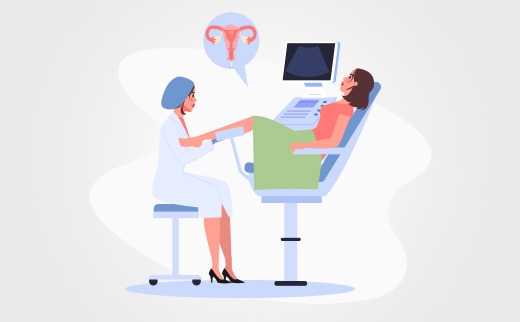
The ovaries are stimulated with daily hormone injections to ensure the growth of a sufficient number of eggs. The drugs used and their doses may vary depending on the person and the treatment protocol applied.
IVF Treatment is started on the second or third day of menstrual bleeding, ultrasonography is performed at regular intervals and the number and size of the developing eggs and the thickness of the endometrium lining the womb are followed. The aim of treatment is to obtain sufficient numbers of eggs. The stimulation phase of the ovaries takes about 9-12 days.
3. Egg Retrieval
It is the process of collecting mature eggs with a needle using vaginal ultrasound under sedation anesthesia. Through vaginal ultrasound the eggs are taken out with the help of a special aspirator connected to the needle. In the laboratory, the egg cell is placed in the culture liquid medium and placed into the incubator. Egg collection takes about 15-20 minutes. After the procedure, the patient rests for a short time.
4. Laboratory
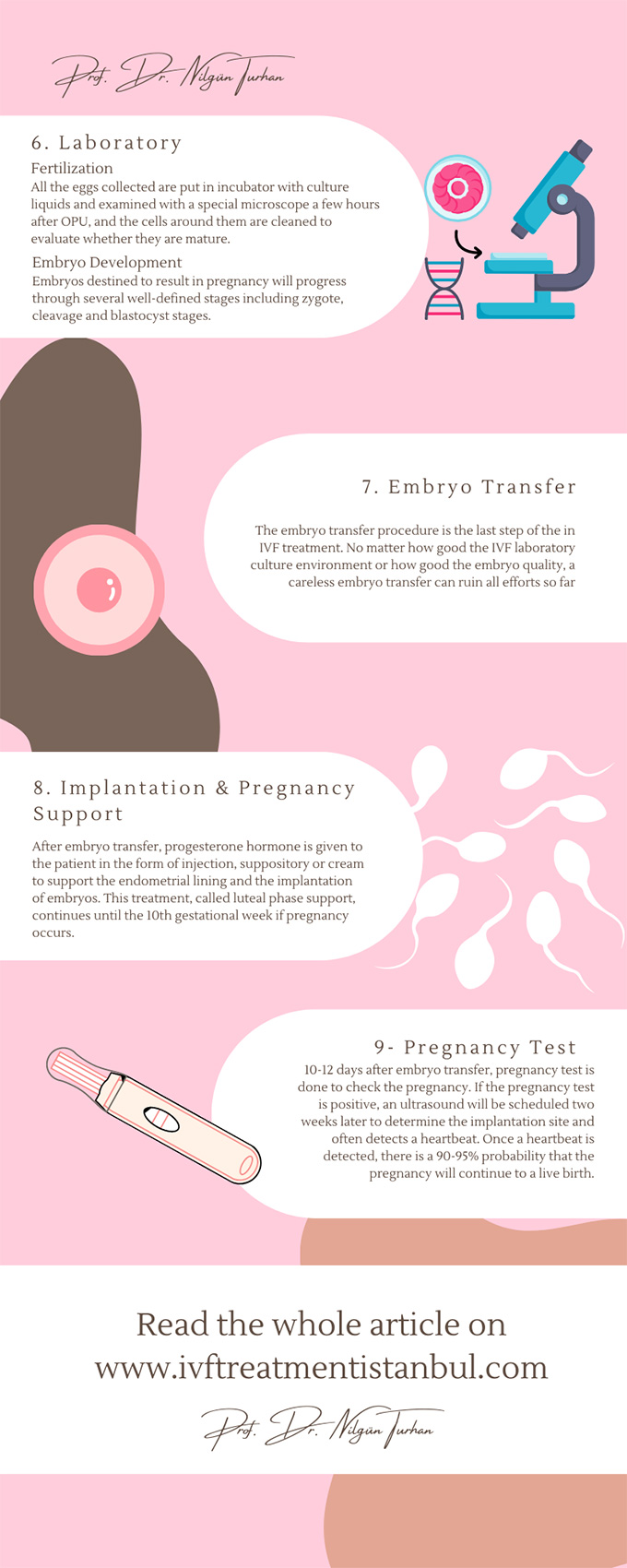
After oocyte retrieval all the eggs are placed in an incubator with culture medium and examined under a special microscope a few hours later. The incubator keeps the temperature 37 ° C and the carbon dioxide ratio constant at 5-6%. Out of all of the eggs collected from 17-20 mm size follicles approximately 80% are mature and ready for ICSI (Intracytoplasmic Sperm Injection).
In the ICSI procedure, a single sperm is injected directly into each mature egg. Fertilisation is assessed approximately 16–18 hours after insemination or ICSI. Developing embryos are then evaluated during the cleavage stage on Days 2–3, and suitable embryos may continue developing to the blastocyst stage on Days 5–6 before embryo transfer or cryopreservation.
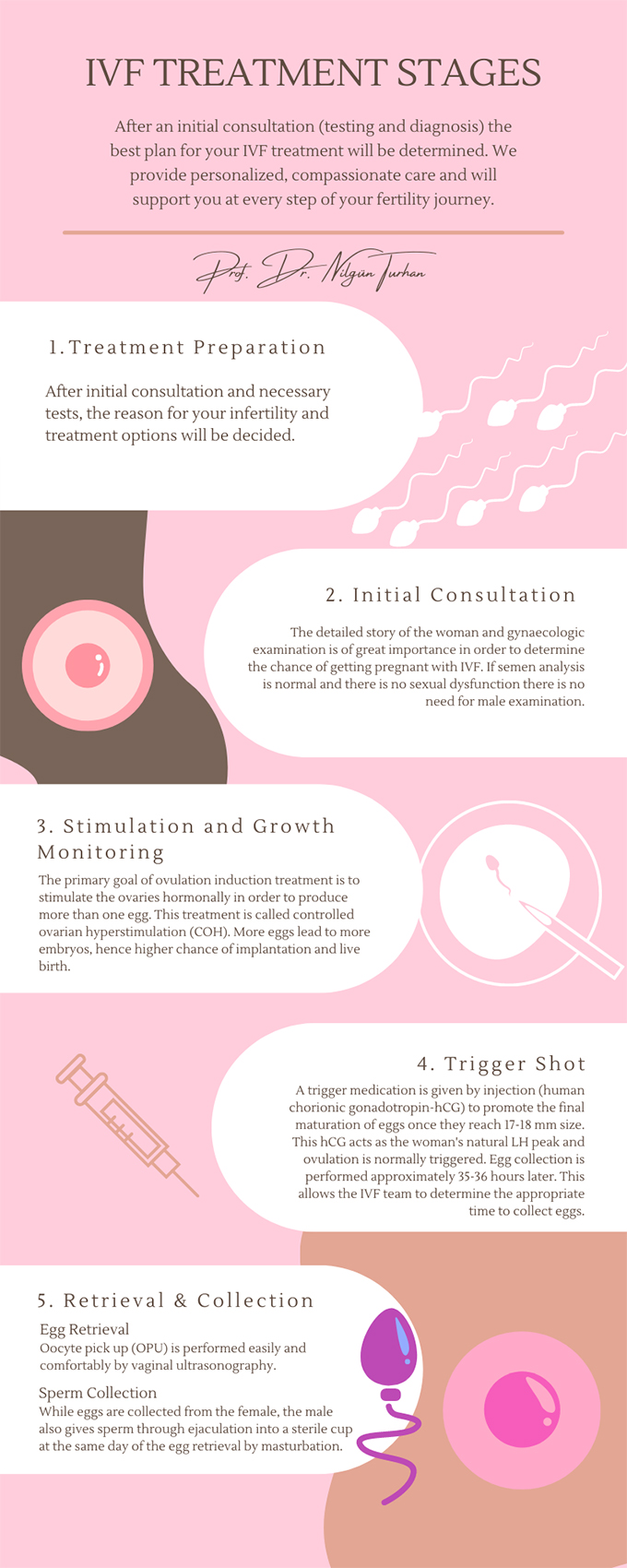
5. Embryo Transfer
At the end of the laboratory process, suitable embryos are selected for transfer into the uterus. In Turkey, the number of embryos transferred is regulated. In women under the age of 35, a single embryo is generally transferred during the first two IVF attempts. From the third attempt onward, or in women aged 35 and over, up to two embryos may be transferred in accordance with Turkish regulations
Embryo transfer is not a painful procedure and does not require anesthesia. After the procedure, progesterone hormone is given to the patient either in the form of injection, suppository or cream to support the endometrium. This treatment, called luteal phase support, and generally continues until the 10th gestational week if pregnancy occurs.
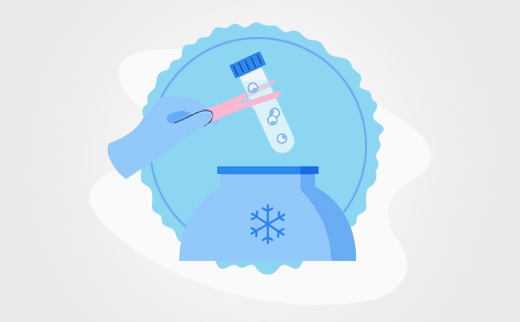
6. Embryo Freezing
After one or two healthy embryos are transferred into the uterus, the remaining good quality embryos are frozen at the same day of embryo transfer or on the 5th day at the latest. In IVF treatment, the frozen embryos can be thawed and placed in the uterus in these situations, if:
- Pregnancy does not occur or,
- The pregnancy results in miscarriage or,
- Second child is desired after the birth of the baby.
Since the administration of hormone drugs to stimulate ovaries will be skipped in this method, the reduction in cost and treatment time also provides convenience to the couple. Freezing the excess embryos obtained in this way provides both an economic and psychological advantage to the patient. Embryo freezing can also be considered as a procedure that increases the chance of success in in vitro fertilization.
7. Pregnancy Test
The last stage of IVF treatment is a pregnancy test. Pregnancy test is performed by measuring the values of Beta-hCG hormone in blood or in urine 12 days after 3rd day embryo transfer or 10 days after 5th day embryo transfer. Two weeks later ultrasound is performed to evaluate the gestational sac and the heart beats of the embryo.
What to do and not to do after embryo transfer?
To increase your IVF treatment success rate in Istanbul it’s better to consider some points after embryo transfer, which is one of the most important stages of IVF Treatment:
Normal light daily activity is generally appropriate after embryo transfer. Routine bed rest is not recommended, although strenuous physical activity should be avoided according to the doctor's advice.
During the following days after the embryo transfer, keep away from any heavy sports activities and sexual intercourse, baths and going to a swimming pool. Smoking, alcohol and drugs should be avoided.
You have to continue all your medications as advised by your doctor. These medications including progesterone will support the luteal phase and will increase the embryos chance to implant to the womb.
Any medication should be under the control of your doctor.
A balanced diet is recommended. Raw or undercooked meat and unpasteurised milk or dairy products should be avoided because of the risk of foodborne infection.
10-12 days while waiting for the pregnancy test are usually very challenging from the emotional and psychological perspective. During this time, it is important to do things that you simply like to do. In addition to all these, you should adopt a stress-free lifestyle, think positively and pay attention to your health.
Why Consider IVF Treatment in Turkey?
Turkey is an established destination for international patients seeking fertility treatment. Patients may consider IVF treatment in Turkey because of access to experienced fertility specialists, modern IVF laboratories, regulated fertility centres and treatment services designed for international patients.
Treatment availability, medical suitability and legal eligibility should be confirmed before travelling. For current package prices and additional treatment expenses, see our IVF Cost 2026 in Istanbul, Turkey guide.
What is the Safety and Quality for IVF Treatment in Turkey?
IVF clinics are subject to legal audits by the Turkish Ministry of Health at every 6 months intervals. They check their equipment, staff, the physical environment and their records. The Ministry of Health revokes the licenses of the clinics that do not comply with the rules and the laws. All the fertility clinics in Turkey send all the reports and the documents and outcomes of the IVF treatments of the patients regularly to the Ministry of Health.
What are the laws of IVF Treatment in Turkey?
Fertility clinics in Turkey have to adhere to government legislation on IVF treatment.
Compared to some countries in Europe, the law in Turkey is quite strict about who is allowed to be treated and which treatments are allowed.
Which IVF treatments are allowed in Turkey?
The law states:
- Couples must be married.
- Only a couple’s own eggs and sperm are used.
- Preimplantation genetic testing (PGT) may be performed when medically indicated.
- Egg freezing is allowed for the following conditions: cancer patients or diminished ovarian reserve or a family history of premature ovarian failure.
- Embryos can generally be stored for up to five years. Storage beyond five years requires approval from the Turkish Ministry of Health, and couples must comply with the applicable consent and storage procedures.
Which IVF treatments are not allowed in Turkey?
- Egg, sperm and embryo donation,
- Surrogacy,
- Single women and lesbian couples,
- PGT for non-medical sex selection is not permitted,
- Although there is no legal age limit for treatment, many clinics do not accept women over the age of 46, considering that only the woman's own egg can be used in IVF treatment.
Is it possible to increase your IVF success rate in Turkey?
IVF treatment is a method that requires the patient and the doctor to cooperate in harmony. Considering some issues about your health increases your chance to get pregnancy.
✓ Before coming for in vitro fertilization treatment in Turkey it would be better to have a healthy weight. Loss of weight in obese patients increases the chance of pregnancy and helps to have a healthier and trouble-free pregnancy.
✓ Also having a healthy balanced diet before coming to Turkey for in vitro fertilization treatment will increase your IVF success rate. Eat fertility-enhancing foods which are rich in antioxidants like leafy greens which are a good source of iron and folate, fruits, nuts and grains. Antioxidants like folate and zinc may improve fertility for both men and women. They deactivate the free radicals in your body, which can damage both sperm and egg cells.
✓ Reducing your stress will help to increase your IVF success rate in Turkey. Before and during IVF treatment in Istanbul, Turkiye, care should be taken to lead a regular and stress-free life.
✓ Avoiding all toxic substances such as cigarettes and alcohol consumption will increase your IVF success rate in Istanbul, Turkey.
✓ It’s better to start a multivitamin containing folic acid.
✓ Vitamin D is an essential nutrient that your body needs for many vital processes, including your IVF treatment success.
✓ Controlling chronic medical conditions such as high blood pressure, thyroid hormone disorders and diabetes may also improve your chance of having a healthy baby.
✓ Optimize sperm health. Semen quality is assessed using several parameters, including sperm concentration, motility and morphology. These findings should be interpreted together with the couple’s overall fertility evaluation. Avoiding smoking, excessive alcohol consumption and other harmful lifestyle factors may support reproductive health.
✓ During your in vitro fertilization treatment in Turkiye try to be patient and insist on your treatment. Some patients need more than one cycle of IVF treatment to achieve an embryo for transfer or pregnancy. When treatment is not successful your medications might be adjusted to optimize your response.
✓ An excellent doctor and embryology laboratory will increase your IVF treatment success.
✓ During the treatment period, you should be at our Fertility Clinic in Turkey for controls. Giving attention to the appointment hours and the recommendations and treatments you are advised will increase your IVF treatment success.
✓ Providing full information about your previous treatments will help the treatment to be more successful in your IVF treatment in Turkey.
How safe is IVF treatment?
IVF is generally considered a safe and well-established treatment, but like all medical procedures it carries potential risks. These may include ovarian hyperstimulation syndrome (OHSS),complications related to egg retrieval, ovarian torsion, ectopic pregnancy and risks associated with multiple pregnancy.
Is there an increase in the rate of anomalies in children born by IVF?
Babies born from IVF have the same low rate of birth defects as babies born from a natural conception. However, a minimal increase in sex chromosome disorders can be seen, especially in patients with severe male factors and undergoing microinjection (ICSI).
Although some studies show a slight increase in anomalies such as heart anomalies, neural tube defects and hypospadias, large series of studies show no significant difference in any congenital abnormalities and also in the development of the children born after IVF as compared to natural conception. In addition, no change is observed in later developments such as behavior and intelligence.
Can IVF treatment damage the ovaries and lead to menopause?
When a baby girl is born, her ovaries contain roughly 2 million oocytes, each encased in a protective covering called primordial follicle. These primordial follicles will sit dormant in a woman’s body for as long as 50 years or more until menopause, waiting for a signal that will cause them to leave the primordial pool and begin slowly to mature.
At the beginning of puberty, the woman has around 400,000 primordial follicles and they are consumed rapidly over the years and by the time of menopause they are almost all gone. During the normal menstrual cycle, most eggs disappear before they reach the mature egg stage and only one of them ovulate.
Along a follicle’s developmental path, from its first step as a primary developing follicle, through its secondary follicle stage, and on to its final stage as an antral follicle. It is the antral follicle that, under the influence of luteinizing hormone (LH) and follicle-stimulating hormone (FSH) will grow into a large mature follicle with a mature oocyte in its fluid core. In IVF Treatment, the development of 10 or more follicles is provided with the stimulation of ovaries with hormone injections, but these are antral follicles that will naturally disappear, so there is no damage to the ovaries.
Do the drugs used have cancer-causing effects?
There has been no proof that IVF treatment or the medications used in IVF lead to an increased risk of ovarian or breast cancers. The hormones used may have side effects that are not serious, but these are temporary side effects.
No permanent carcinogenic effect has been demonstrated in large studies. The hormones that are used in the IVF treatment are widely used in all parts of the world and each preparation is put on the market after strict controls.
Frequently Asked Questions About IVF Treatment in Turkey
Who Is IVF Treatment in Turkey Suitable For?
IVF treatment in Turkey may be considered for couples with blocked or damaged fallopian tubes, ovulation disorders, male factor infertility, endometriosis, diminished ovarian reserve, unexplained infertility or previous unsuccessful fertility treatments.
IVF is not necessarily the first treatment option for every couple. Age, ovarian reserve, semen analysis, reproductive history and previous treatments should be evaluated before deciding whether IVF is appropriate.
What Are the Main Stages of IVF Treatment in Turkey?
A standard IVF cycle generally includes ovarian stimulation, monitoring with ultrasound and blood tests, final egg maturation, egg retrieval, sperm preparation, fertilisation with conventional IVF or ICSI, embryo culture and embryo transfer.
The treatment protocol, medication doses and timing of each stage are individualized according to the patient's ovarian reserve, age and response to stimulation. Current ESHRE guidance similarly emphasizes individualized ovarian stimulation rather than using the same protocol for every patient.
How Long Does IVF Treatment in Turkey Take?
A complete IVF treatment cycle generally requires approximately 15–17 days, although the exact duration may vary according to the stimulation protocol and ovarian response.
Egg retrieval cannot always be scheduled to an exact date before treatment begins because follicular development must be monitored. International patients should therefore allow some flexibility in their travel plans.
Can I Complete My Fertility Tests Before Travelling to Turkey?
Yes. International patients can often complete part of their fertility evaluation in their home country before travelling to Turkey.
Recent hormone tests, AMH results, pelvic ultrasound findings, semen analysis, previous IVF reports and embryology records can be reviewed before treatment planning. This may help avoid unnecessary repetition of tests and allows the medical team to prepare a more individualized treatment strategy before the patient travels.
When Is ICSI Used During IVF Treatment in Turkey?
ICSI, or intracytoplasmic sperm injection, involves injecting a single sperm directly into an egg.
It may be considered in cases of male factor infertility, reduced sperm quality, previous fertilisation problems or other clinical situations in which conventional fertilisation may be less appropriate. The decision between conventional IVF and ICSI should be based on the couple's individual fertility findings rather than used automatically in every case. Turkish Ministry of Health fertility centres also describe both conventional IVF and ICSI as laboratory fertilisation options.
Can Women With Low AMH Have IVF Treatment in Turkey?
Low AMH does not automatically mean that IVF treatment cannot be performed.
AMH provides information about ovarian reserve, but treatment planning should also consider age, antral follicle count, previous response to stimulation and other reproductive factors. Patients with reduced ovarian reserve may require a more individualized ovarian stimulation strategy, and the expected ovarian response should be discussed realistically before treatment. ESHRE's current ovarian stimulation guideline specifically addresses individualized management, including low responders. (ESHRE)
Can Embryos Be Frozen After IVF Treatment in Turkey?
Yes. If suitable embryos remain after treatment, they may be frozen with the consent of both spouses for possible future use.
Turkish assisted reproduction regulations include specific rules regarding embryo storage and consent. Under the regulation, stored embryos may generally be kept for up to five years; storage beyond this period requires Ministry approval.
How Many Embryos Can Be Transferred During IVF in Turkey?
The number of embryos transferred during IVF treatment in Turkey is regulated to reduce the risk of multiple pregnancy.
In women under the age of 35, a single embryo is generally transferred during the first two IVF attempts. In women aged 35 and over, or from the third IVF attempt onward, up to two embryos may be transferred in accordance with Turkish regulations.
The final transfer plan also depends on embryo development and the patient's individual clinical situation.
Can Unmarried Couples Have IVF Treatment in Turkey?
No. Under the current Turkish assisted reproduction regulations, couples applying for IVF treatment must be legally married and undergo treatment together.
The regulation requires identification and marriage documentation before assisted reproductive treatment can begin.
International patients should therefore confirm their eligibility under Turkish regulations before organizing treatment and travel.
Are Egg Donation, Sperm Donation or Embryo Donation Allowed in Turkey?
No. Turkish assisted reproduction regulations define treatment using the woman's own oocyte and her husband's sperm.
Therefore, donor eggs, donor sperm and donor embryos are not permitted as part of IVF treatment in Turkey.
Patients who specifically require donor-based treatment should take this legal restriction into consideration before planning fertility treatment in Turkey.
Scientific and Regulatory Sources
- World Health Organization (WHO) – Infertility Fact Sheet. Current overview of infertility definitions, causes and global prevalence. (Dünya Sağlık Örgütü) WHO – Infertility
- ESHRE – Guideline on Ovarian Stimulation for IVF/ICSI, 2025 Update. Evidence-based recommendations covering stimulation protocols, monitoring, ovarian response, triggering, individualization and OHSS prevention. (ESHRE) ESHRE – Ovarian Stimulation for IVF/ICSI
- ESHRE – Good Practice Recommendations in IVF Laboratories, 2026. Covers IVF laboratory organization, quality management, sperm preparation, fertilisation, embryo culture, embryo transfer and cryopreservation. (ESHRE) ESHRE – Good Practice in IVF Laboratories 2026
- ESHRE – Guideline on the Number of Embryos to Transfer During IVF/ICSI. Evidence-based recommendations concerning embryo transfer strategy and avoidance of unnecessary multiple embryo transfer. (ESHRE) ESHRE – Embryo Transfer Guideline
- ESHRE – Evidence-Based Guideline on Unexplained Infertility. Recommendations covering diagnostic evaluation and treatment strategies for couples with unexplained infertility. (ESHRE) ESHRE – Unexplained Infertility Guideline
- Republic of Türkiye Ministry of Health – Assisted Reproductive Treatment Regulations. Official framework covering patient eligibility, marriage requirements, reproductive cells, embryo storage and assisted reproduction centres in Turkey. (Ankara İSM) Ministry of Health – Assisted Reproductive Treatment Regulation




 Appointment
 Contact
 Ask a question